
March update: Rethinking compute and rewiring plant immunity
What’s new at ARIA
News and opportunities
We’re looking for a partner to co-design, build, and maintain a successful Arena for our Scaling Trust programme. This partner will deliver a robust testing ground designed to identify how well current systems work. Find out more and apply before 14 April.
Full proposals are open for Enduring Atmospheric Platforms. Help us to unlock a digital infrastructure layer between the Earth and space – apply for funding by 2 April.
We’re opening applications for our next Activation Partners cohort – read our concept note now before the funding call goes live on 1 April.
There are two days left to apply to Pillar VC x ARIA’s Encode Fellowship. Fellows get 12 months of salary, compute, and total freedom to build. Apply by 28 March through a short (<20 minutes) form.
Applications are now open for the Cambridge NeuroWorks ‘Part Time What If’programme, for those looking to develop novel technologies to address urgent needs in neurological conditions and brain health. Apply by 7 April.
Events
Connect with startups, researchers, investors, and more at Venture Café’s Thursday Gathering events across London, Manchester, and Edinburgh:
Venture Café London: Launching Meridial and Echo Labs (31 March), AI for Science (2 April), Preparing for Driverless Cars (9 April), Beyond Sustainability (16 April), The TechBio Shift (23 April), Humans, Agents + Work (30 April)
Venture Café Edinburgh: People, Planet, Progress (23 April), The Intelligent Body (30 April)
Venture Café Manchester: Climate, Capital and Carbon (9 April), Neurotech Unlocked (23 April)
Join Nucleate UK for an in-depth exploration of the ARIA ecosystem (5 May)



Developing a world-first thermodynamic computing chip
What if we could exploit principles found in natural systems to build dramatically more efficient computers? This question is at the heart of our Nature Computes Better opportunity space – and one that is only becoming more important as demand for computing power to train and use AI grows dramatically.
For decades, we have benefited from exponentially more computing power at lower cost. However, that trajectory is no longer a given; we have reached a point where we must fundamentally rethink our approach to computing.
“Modern day AI requires orders of magnitude more energy than the intelligence afforded to us through nature. We know highly efficient intelligence is possible, we just don’t know how to build it,” says Suraj Brahmavar, Programme Director.
The Thermodynamic Matrix Inversion project, funded through our Scaling Compute programme, sets out to tackle this challenge. The project is exploring how we can harness the laws of physics to create a new class of computer chips, so-called ‘thermodynamic’ computer chips, with the aim of making radically more efficient computers. It is led by Normal Computing, a startup founded by ex–Google Brain and Google X researchers behind early advances in physical-world AI and leading frameworks for probabilistic and quantum AI.
“Normal is questioning core principles of the digital paradigm to adhere more closely to modern AI algorithms. This project is the perfect embodiment of the Nature Computes Better opportunity space, exploring missing links between nature and modern-day computing, and trying to exploit these links to re-build our compute infrastructure with scalability top of mind from day one,” says Suraj.
Working with, not against, the laws of physics
Conventional computer chips (like CPUs or GPUs) are strictly digital, performing computations using billions of tiny switches that are either On (1) or Off (0). This requires the chips to be perfectionists – if there is even a tiny bit of ‘noise’, the chip can make a mistake. To maintain this precision, these chips have to expend a massive amount of energy fighting a constant war against the natural, chaotic vibration of atoms.
Normal’s approach tries to turn this on its head by actively working with this natural chaos. By leveraging physical fluctuations to perform computations, they aim to unlock a fundamentally new and radically more efficient architecture specifically designed for heavy AI workloads like image and video generation.
“Stochastic computing – instead of trying to be a tightly controlled, rigid, deterministic process – works with a modelling of the noise in silicon chips that we’re normally trying to suppress,” says Marc Bright, Silicon Team Lead at Normal. “That suppression is where a lot of the power cost comes from. We work with the randomness and that gives us an ability to reduce power density and consumption so that we can avoid hitting these maximum temperature limits.”
Since beginning their ARIA project in October 2024, Normal has moved with remarkable speed, launching and growing their London operations to a team of seven who have come together to reach a significant research milestone.
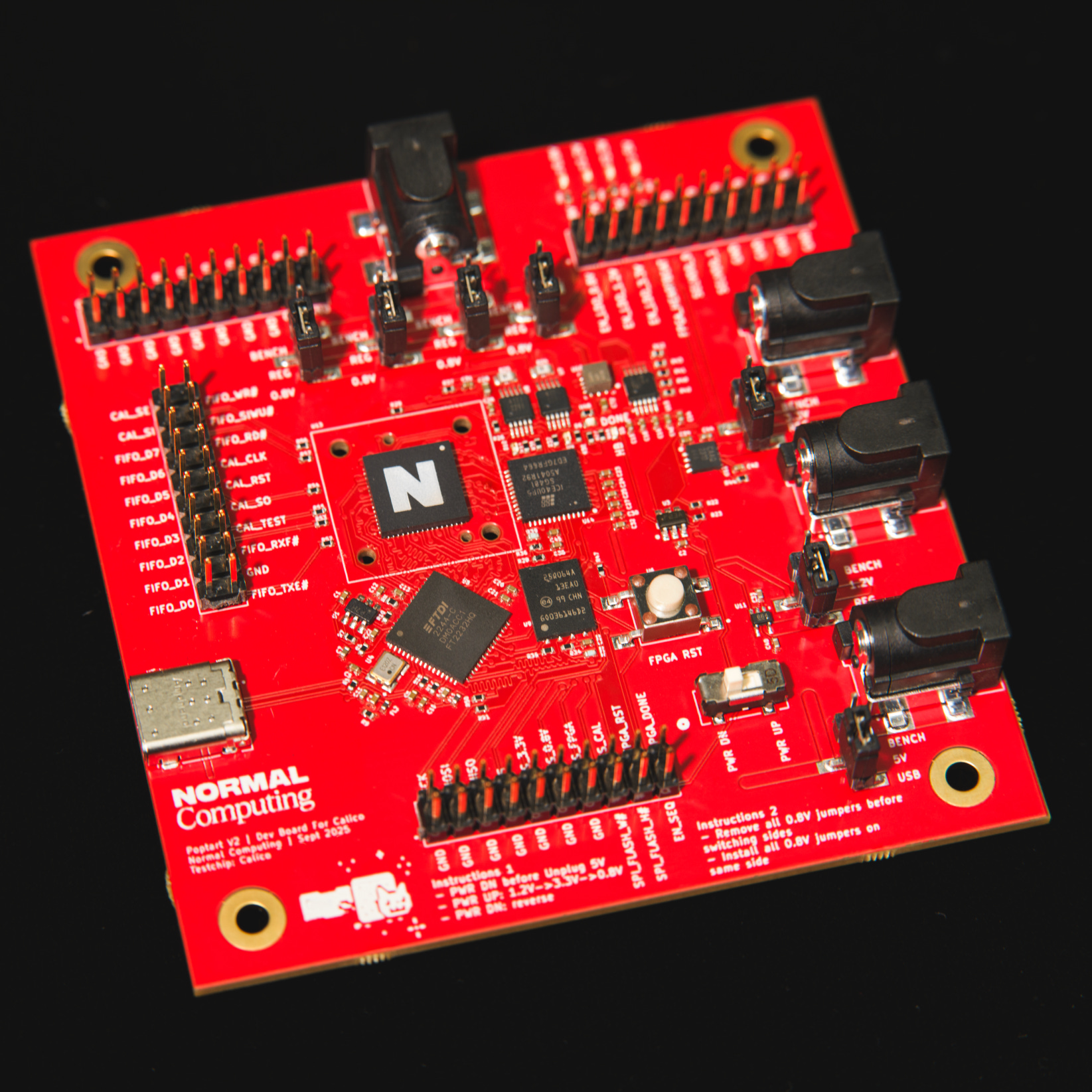
In June 2025, the team created CN101, the world’s first thermodynamic computing chip. Designed specifically for multi-modal diffusion GenAI model inference, this chip represents the first step on a roadmap targeting 1000x gains in energy efficiency and dramatically lower latency.
The real test
Creating a chip is an achievement in and of itself, but does the chip actually work? In an anxious but exciting moment for the whole team, in August 2025, the team ran the first chip’s first test.
“This particular chip was being brought up by one of our colleagues in LA, and he was looking at it at 8pm my time in the UK. I couldn’t bear to find out that it didn’t work, so I muted my notifications until the following morning,” says Marc.
“When I woke up, I saw that he was producing data out of the chip and that was a massive moment.”
The test was a success, a monumental first step in scaling this thermodynamic computing paradigm.
But this is only an early signal. It remains unclear how far this approach can scale, or whether the same behaviour will hold across different models and workloads. Can thermodynamic systems maintain useful signals as they grow in size? Where does noise enable computation, and where does it begin to degrade it? These are the questions that now define the next phase of the work.
“ARIA exists to fund the ideas where the potential impact is not marginal but transformational, even when the technical risk is high,” says Suraj. “Normal’s team has taken a fundamentally unconventional approach and delivered working silicon in CN101. That is an exceptionally rare outcome for work this ambitious and we are excited to witness this next phase of the journey.”


From strength to strength
The team’s technical success has also paved the way for significant commercial momentum. Normal recently announced $50 million in strategic funding led by the Samsung Catalyst Fund, bringing its total funding to more than $85 million.
New investors also include Galvanize, an investment firm focused on energy innovation founded by Tom Steyer and Katie Hall making its first semiconductor investment, and ArcTern, alongside existing investors Celesta, Drive Capital, Eric Schmidt’s First Spark Ventures, and Micron Ventures.
“CN101 proved that thermodynamic computing opens a fundamentally new path forward. We use our own AI to design these chips, with each generation improving the next. ARIA’s backing accelerates us toward multiple-order-of-magnitude efficiency gains for datacenter silicon,” says Faris Sbahi, Founder and CEO of Normal.
Bridging tech’s valley of death
Despite milestones like CN101 being reached, work like this also highlights a broader challenge. Startups developing novel AI hardware face a key challenge – they lack a “shop window” to showcase their innovations. They are forced to develop components in isolation, requiring huge capital investment and dependency on hyperscalers to access compute.
To address this, ARIA has committed an additional £50m to the Scaling Compute programme to launch the Scaling Inference Lab. This AI testbed will prioritise rapid iteration and open collaboration, ensuring that innovative, world-first technologies developed by startups like Normal have a clear path to deployment.
“We’re incredibly excited about what comes next,” says Craig Churchill, CBO of Normal. “Thermodynamic computing represents a fundamentally new approach to computation, and initiatives like the Scaling Inference Lab are critical to turning breakthroughs like CN101 into real-world impact at scale.”

Enhancing plant immunity: A Q&A with Philip Carella from the John Innes Centre
Philip Carella is leading an opportunity seed project within our Programmable Plants opportunity space. His team is working to rewire plants’ immunity to better fight pathogens. We caught up with Philip to learn more.
What are you currently working on?
Our team is developing a modular and programmable platform for enhancing plant immunity. We’re taking inspiration from the vast diversity of defensive mechanisms that evolved across the tree of life to develop innovative strategies to combat plant diseases. Our work involves designing and implementing immune circuits from other natural kingdoms – bacterial, fungal, and animal – then generating a library of synthetic constructs and testing their efficacy against key crop pathogens in a model plant.
We’re particularly amazed by the molecular diversity of modular anti-phage immune systems in bacteria and archaea that make exciting candidates for engineering plants’ immunity against viruses. Our hope is to better protect crops against a host of pathogens, ultimately helping to safeguard the world’s food system.
What do you wish more people knew about your research area?
Many people assume that immunity is highly specialised and specific to the organism in question – and in many ways, it is – but there are actually very striking similarities between mechanisms evolving independently across the tree of life. This really hints that there are common underlying principles of organismal immunity that we can leverage to develop programmable immunity in plants.
Thinking beyond the immediate objectives of your ARIA project, if the technology you’re building is wildly successful, what’s the most ambitious or blue-sky application you could imagine for it in 15 years?
We’d like to rationally design and implement ‘plug and play’ immune circuits that could be integrated into a broad range of crops to protect against emerging pathogens, essentially rewiring plants’ immunity beyond the constraints of their evolutionary history. In a rapidly changing climate and an agricultural system under ever-increasing pressure, bolstering plants’ ability to fight off pathogens could vastly improve crop yields, ultimately moving the needle on food security.
Which book/film/TV show should people check out to understand your project or discipline more?
I’d highly recommend Nausicaä of the Valley of the Wind, an animated film from 1984 and directed by Hayao Miyazaki. It’s a beautiful story about living systems, adaptation, and how there is much we can and should learn from the natural world, rather than simply trying to dominate it. That’s pretty close to how we think about our explorations into the vast diversity of immune systems that evolved on our planet.

Activation Partners: Launching applications for our second cohort


More than a year into our Activation Partners initiative, we reflected on what we’ve learned from our first cohort, and how the right partnerships can build the conditions to translate breakthrough R&D into real-world impact.
On April 1, we’re launching a call for a new cohort of Activation Partners. Alongside science translation, we’re expanding our scope, drawing on insights from our AI Scientist initiative to apply advanced AI capabilities – from AI for Science models to autonomous labs – to our funded-R&D.
Read the concept note here to learn more and sign up here to be notified when the call goes live next week.

F-Spec corner: Recommended reads
Our Frontier Specialists (F-Specs) are a small, dedicated team with the mission to dramatically expand ARIA’s technical surface area and sharpen the cutting edge of the science we’re funding.
Here are some of the pieces that F-Spec Matt Burnett has been digging into this month:
Using a GPT-5-driven autonomous lab to optimize the cost and titer of cell-free protein synthesis
Last month, Ginkgo Bioworks and OpenAI released an interesting paper detailing a collaborative experiment between OpenAI’s model GPT-5 and Ginkgo’s cloud lab.
The experiment showed how an AI system, given the ability to recursively run experiments, can optimise protein production better than the best human experts.
With GPT-5 in the driver’s seat, over six iterations each running multiple 384-well plates, the experiment improved cell free protein synthesis specific cost by 40% and increased protein titre 27% compared to the state of the art.
There was still some hand-holding from human experts, but this is the closest to a human-out-of-the-loop embodied AI Science experiment, with field-leading results, I have seen to date.
A community effort that’s been running since its first release in 2021, the AllTheBacteria project uniformly assembles bacterial genome data enriched with searchable indexes. The latest releases bring the number of genomes assembled close to three million.
There is a lot of data that has been generated across scientific fields, but is unwieldy to interrogate because of different standards, metrics, repositories, lack of metadata, and more. This initiative is doing the unglamourous work of assembling data in a way that can be easily interrogated, and enriching the dataset through systematic annotation and predictions of function such as antibiotic resistance genes.
It is these kinds of efforts that will radically increase the speed at which AI can be used to accelerate discovery.
AI Scientists Need a Social Network
Two Encode Fellows, William Bolton and Ben Williams, have written a letter to the Society for Technological Advancement (SoTA) proposing two models for social networks for AI Scientists (that is, AI systems performing scientific discovery). Of the two, I prefer the GitHub-inspired one, but the concept of an online forum for the sharing, validating, and improving of scientific knowledge seems inevitable. However, it is far from certain that what emerges in this space will be done well.
This letter suggests some important characteristics of an effective AI Science social network, including moderation systems, filtering for information hazards, and architectures that incentivise productive use. I hope this will be the start of a larger conversation about what the future of science knowledge dissemination should look like – and how we get there.

Thanks for reading – subscribe below to receive new posts ↓