
January update: Thoughts from our outgoing CEO, world-changing founders, and bio-inspired robot hands
What’s new at ARIA
Kathleen Fisher joins as ARIA’s CEO on Monday – dive into her track record of impact, and reflections from those she’s worked with to learn why she’s the right leader for ARIA’s next phase in this profile piece.
Speaking at the Roots of Progress conference, our founding CEO Ilan Gur reflected on the opportunity to re-engineer the institutions of scientific progress – and the experimentation that has defined our first three years. Watch the full talk, and read his thoughts on boldness at ARIA below.
In our latest opportunity space, Extending Our Perception, PD Claire Donoghue explores if we can build integrated systems of sensing and AI to tackle the world’s most critical challenges. Discover the space and give feedback to inform our work.
Backed by £6m over nine months, we’re funding exploratory AI Scientist projects to test whether AI systems can plan and run scientific experiments in the real world – learn more about the projects and our AI Scientist work.
Our latest programme, Enduring Atmospheric Platforms, aims to develop low-cost, persistent, and autonomous atmospheric platforms. The full call for proposals opens 20 February – learn more about the programme.
Applications are closing soon for opportunity seed funding in the Engineering Ecosystem Resilience opportunity space, where we’re asking: what if we could engineer resilient ecosystems that enable both humanity and nature to thrive? Apply by 2 February.
As part of new university scholarships for International Mathematical Olympiad gold medallists, ARIA will coordinate internships, connecting scholars with our Creators and world-leading research teams, startups and labs across our network. Find out more.
Apply for the third cohort of 5050 UK from Fifty Years. Learn more about our Activation Partner’s flagship programme in the spotlight below, and apply by 15 February.
Applications for cohort two of the Encode: AI for Science Fellowship, run by Pillar VC and powered by ARIA, will open on 15 February. If you’re an exceptional AI/ ML engineer who wants the freedom to build something that matters at the intersection of AI and science, express your early interest now and join the launch event on 19 February (part of the AI for Science series).
Pillar VC and Nucleate UK – both ARIA Activation Partners – are touring Bristol, Sheffield, York, and Edinburgh to find the most ambitious frontier builders, early founders, and researchers. Discover the events from 23 - 27 February.

Stay bold, ARIA: A note from Ilan Gur
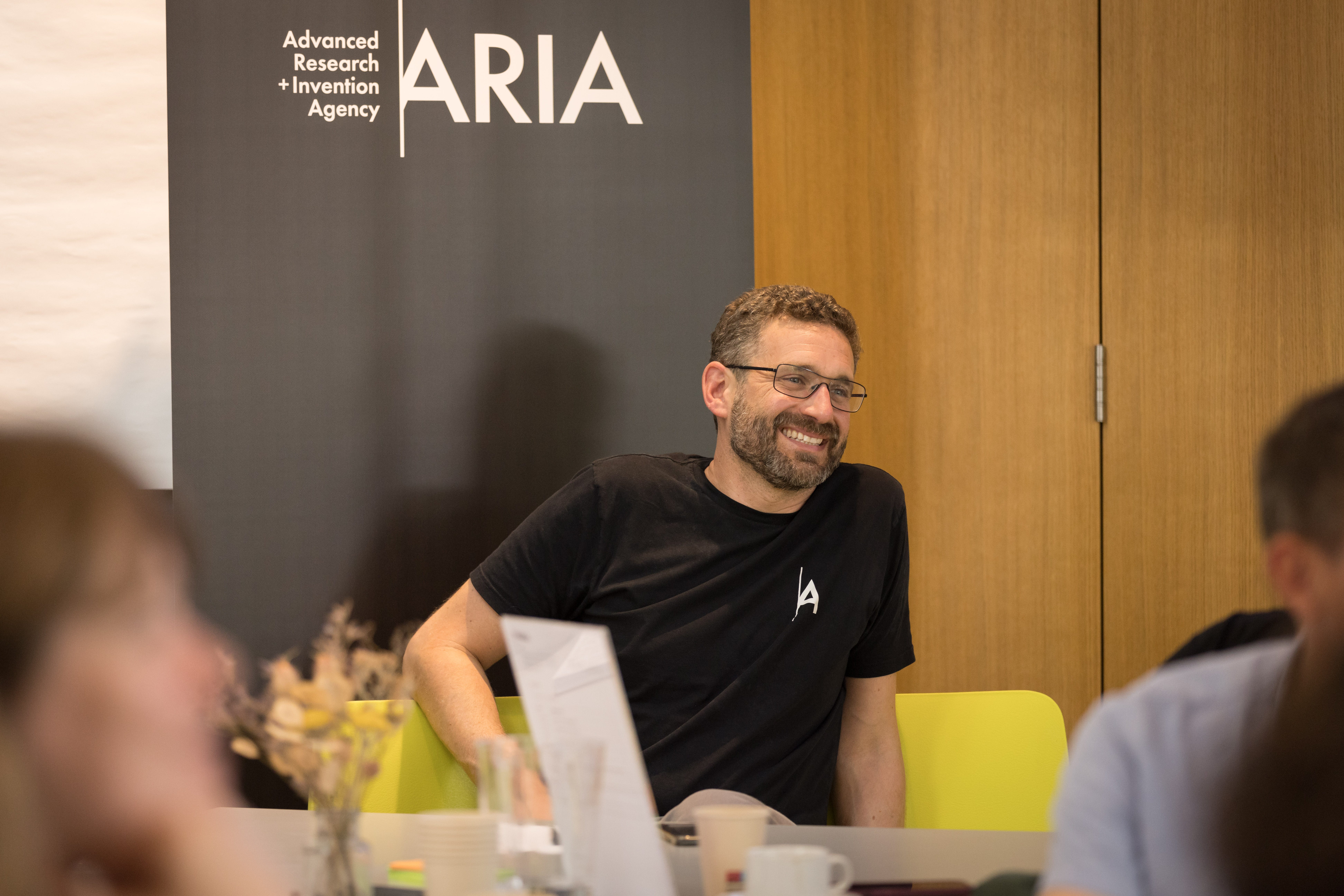
As I reflect on my tenure as ARIA’s founding CEO there’s much to be grateful for, and much to be proud of. But one thing stands out above the rest: we’ve always taken the bold path.
In big and small ways, our decisions have been driven by hunger for impact rather than fear of failure. We launched ARIA with a wide-open call for Programme Directors, betting on the fact that exceptional talent would emerge and lead us to bigger opportunities than any strategic analysis could yield. We released our first seed solicitation – committing to a three-page application and three-week decision timeline – before we even had systems in place to sign contracts or move money. We backed exceptional people no matter their background, in spite of raised eyebrows – whether in giving Programme Directors licence to build programmes in fields they hadn’t previously worked in, or selecting an unknown startup in Sheffield as a critical partner alongside giants like Google DeepMind. We politely thanked world experts for their concerns that certain programmes were ‘impossible’, recognising that scepticism from at least some experts is a necessary signal that we’re onto something paradigm shifting.
If ARIA succeeds in changing the world, it will be because this commitment to boldness started at inception. The organisation was conceived by a set of government leaders and civil servants who put aside partisan differences in a shared belief that ARIA could activate UK talent in transformative new ways. They ensured we would have the flexibility to experiment, the freedom to pursue near-impossible breakthroughs, and the patience needed for those bets to pay off. The ambition of the ARIA Act, and the resolve of its architects, is what convinced me in 2022 to move halfway across the world with my family for this job. I was fully aware of the risks but – inspired by their efforts – I took the bold path, focusing instead on all the ways it could go right (and what that could mean for the world).
I’ve since borne witness to a chain reaction of bold belief. I’ve seen it in the civil servants who kept fighting for ARIA to work differently. In our Board and Advisors who pinned their reputations to that of a fledgling experiment, pushing us to make the most of it. In the incredible, dedicated team that has built ARIA from scratch. In the research ecosystem’s response to ARIA, and their willingness to engage with new ideas and experiment with entirely new ways of working. And in the world-class firms who ‘went big’ on the UK as ARIA Activation Partners, rallying around Britain’s outsized potential for breakthrough innovation.
Most importantly, this tidal wave of belief has buoyed the creative ambition of hundreds of researchers who are now funded by ARIA. Talent from around the UK and beyond – from startups, universities, multinational companies, and non-profits – have bet their careers on the fact that ARIA truly exists to support their most audacious ideas. They are the tip of a spear that’s driving headstrong toward a better future. I believe their efforts will bring about a step change in health, prosperity, and planetary resilience.
There is nothing more important for ARIA than to keep choosing the bold path. Outside forces will inevitably push toward normalcy and conservatism. That pressure will be the biggest risk to ARIA’s mandate in the years to come. But boldness is essential. Because boldness has the power to transform. As the mountaineer W. H. Murray famously observed, “the moment one definitely commits oneself, then Providence moves too”. Commitment sets off a chain reaction – unexpected help, unlikely allies, and a path to the summit no plan could have predicted.
Reaching the end of my term is bittersweet. ARIA is still early, still gathering steam. But we are committed, and the chain reaction has begun. So I leave excited to watch from afar the bold new paths yet to be forged under Kathleen’s leadership, driven by this community.
Stay bold, ARIA. Keep stretching for world-changing impact, even if you risk falling. Trust that your courage will inspire others to join the fray. Before long, what once seemed impossible will become inevitable.
Concerning all acts of initiative (and creation), there is one elementary truth that ignorance of which kills countless ideas and splendid plans: that the moment one definitely commits oneself, then Providence moves too. […] Whatever you can do, or dream you can do, begin it. Boldness has genius, power, and magic in it. Begin it now.
W.H. Murray
Activation Partners: Backing great scientists to build world-changing companies with Fifty Years
Our Activation Partner Fifty Years is a company builder and pre-seed to seed focused VC firm backing researchers pursuing breakthrough technologies to solve the world’s biggest problems, from the climate crisis and life-threatening diseases to connectivity and malnutrition. With applications now open for the third UK cohort of their flagship 5050 programme, we dive into what they’ve achieved in the UK so far as a result of our partnership and how scientists and engineers can get involved.
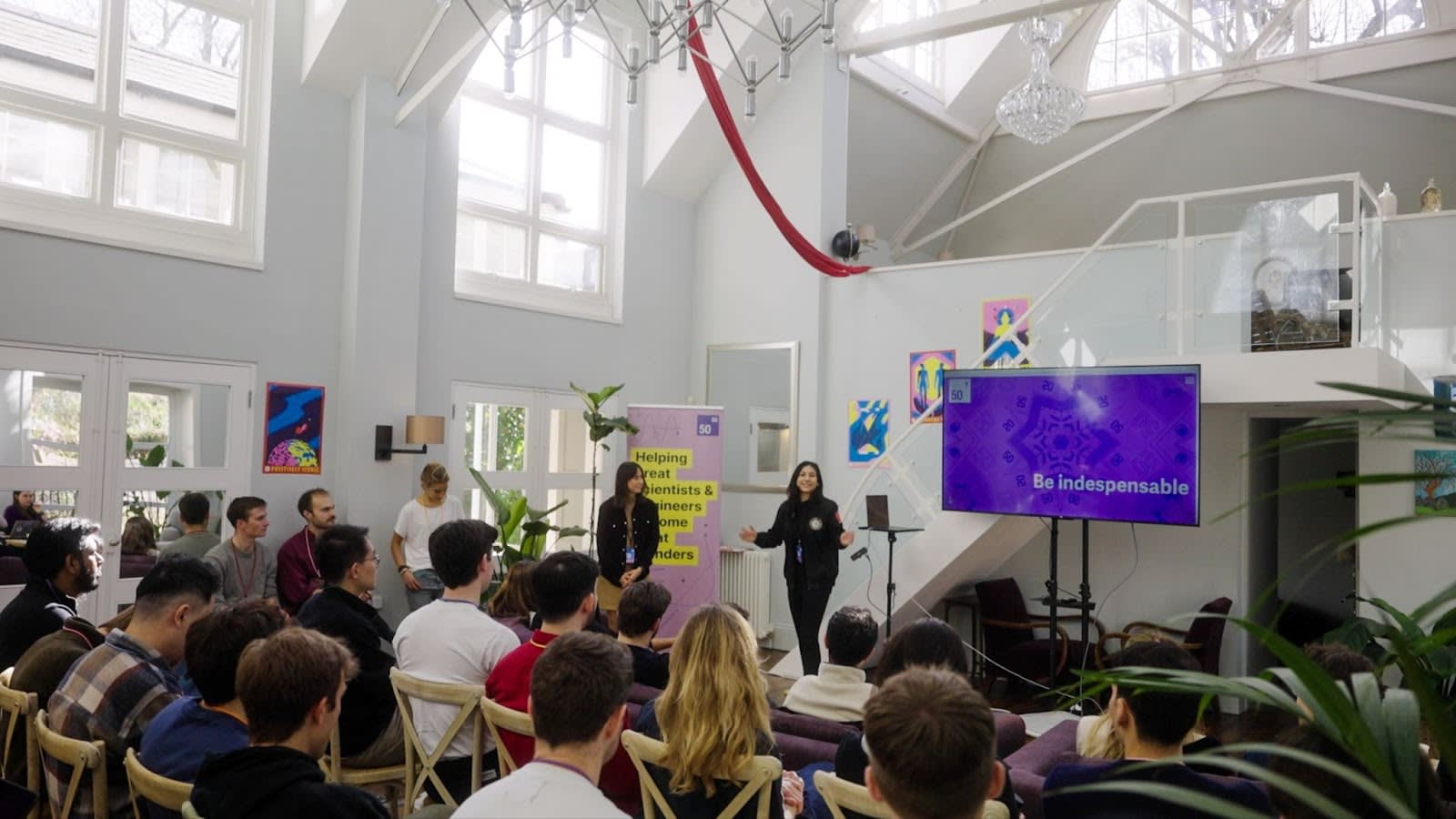
Together with ARIA, Fifty Years launched the 5050 programme in the UK — an equity-free deep-tech company builder supporting scientists and engineers to take research from the lab into world-changing companies, whether they’re ready to build or still exploring if entrepreneurship is right for them. “The UK has four of the top 10 research universities in the world, but a deep tech ecosystem roughly the size of Palo Alto’s,” says Seth Bannon, Founding Partner at Fifty Years. “It might be the largest gap in the world between the calibre of talent and the robustness of the deep tech ecosystem. 5050 aims to close that gap.”
Just over one year into our partnership, 5050 has unlocked exceptional latent technical ambition from around the UK. Across the two cohorts, they’ve supported 86 scientists and engineers to found 26 deeptech companies that have raised a combined £7.75m+ to take R&D from the lab to civilisationally important companies. “We’ve been incredibly excited by the quality of the talent,” says Steph Avraamides, UK Lead at Fifty Years. “ARIA has been an amazing partner for us in the UK, making it possible for us to launch about five years earlier than we otherwise could have. The alignment’s been strong from the start – both teams care deeply about ambition, speed, and backing work that actually matters. That’s shaped who we recruit and the ventures that come out of the programme.”
Prospective founders join 5050 with unique technical insights in fields spanning ARIA’s opportunity spaces – from robotics to synthetic biology and immunology – with many working at the intersection of multiple disciplines, benefitting from the intra-cohort collaborations 5050 enables. A specialised AI safety track formed around our Safeguarded AI space has brought in as mentors the co-founders of OpenAI, Anthropic, and the Future of Life Institute to advise on how AI alignment research can reach the labs and systems needed to maximise impact. “I joined 5050 while finishing my PhD in multi-agent AI systems, with my experience almost entirely in academic research.” says David Hyland, Postdoctoral Research Associate at the University of Oxford. “The programme filled in critical gaps I didn’t know I had – from identifying meaningful markets to de-risking technology and building real partnerships with customers and investors. 5050 reshaped how I think about translating AI research into companies that move AI safety from papers into practice.”


Many come into the programme as ‘entrepreneurially curious’, but doubtful over whether their research can create a globally-impactful startup, whether founding a startup is for them, or how to begin pursuing it. One UK researcher working around the Manufacturing Abundance opportunity space joined the programme unsure they were ready to found a company, and sceptical that their idea could attract venture funding. They have since raised £1.5m and are now building full-time in London.
“What’s often missing isn’t ability – it’s confidence and permission,” says Seth. “Many researchers don’t initially see their work as venture-scale, or assume starting a company isn’t for them. Once that mindset shifts, things can move very quickly. The UK felt particularly ready for that kind of push.”
Have a world-changing idea you want to get off the ground? Applications are now open for the third cohort: a 14-week programme running March-June 2026 to get you ready to found a deep tech startup. Apply by 15 February.
Robot hands with human capabilities: A Q&A with Udayan Bulchandani (Arthur Robotics Ltd)
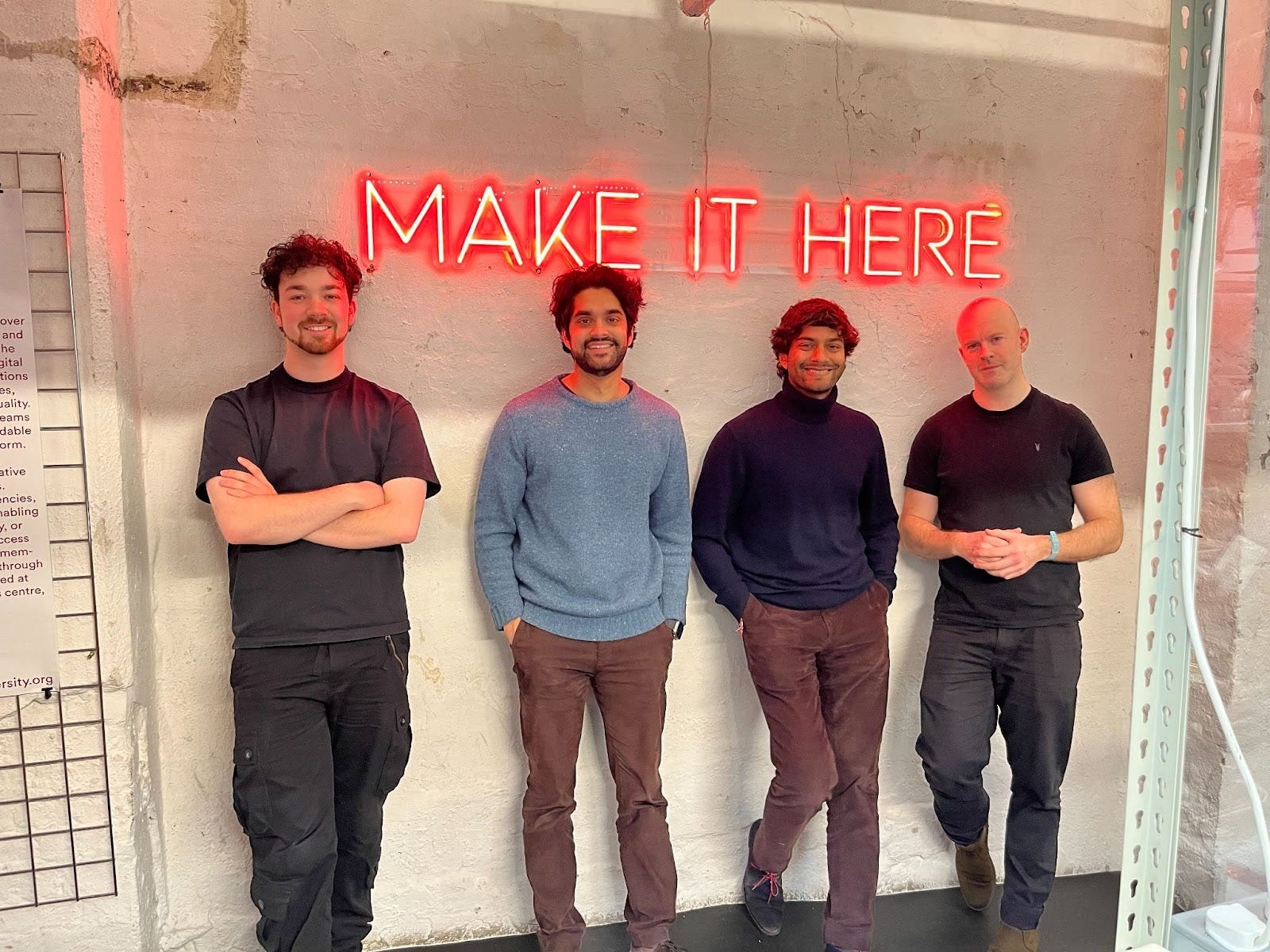
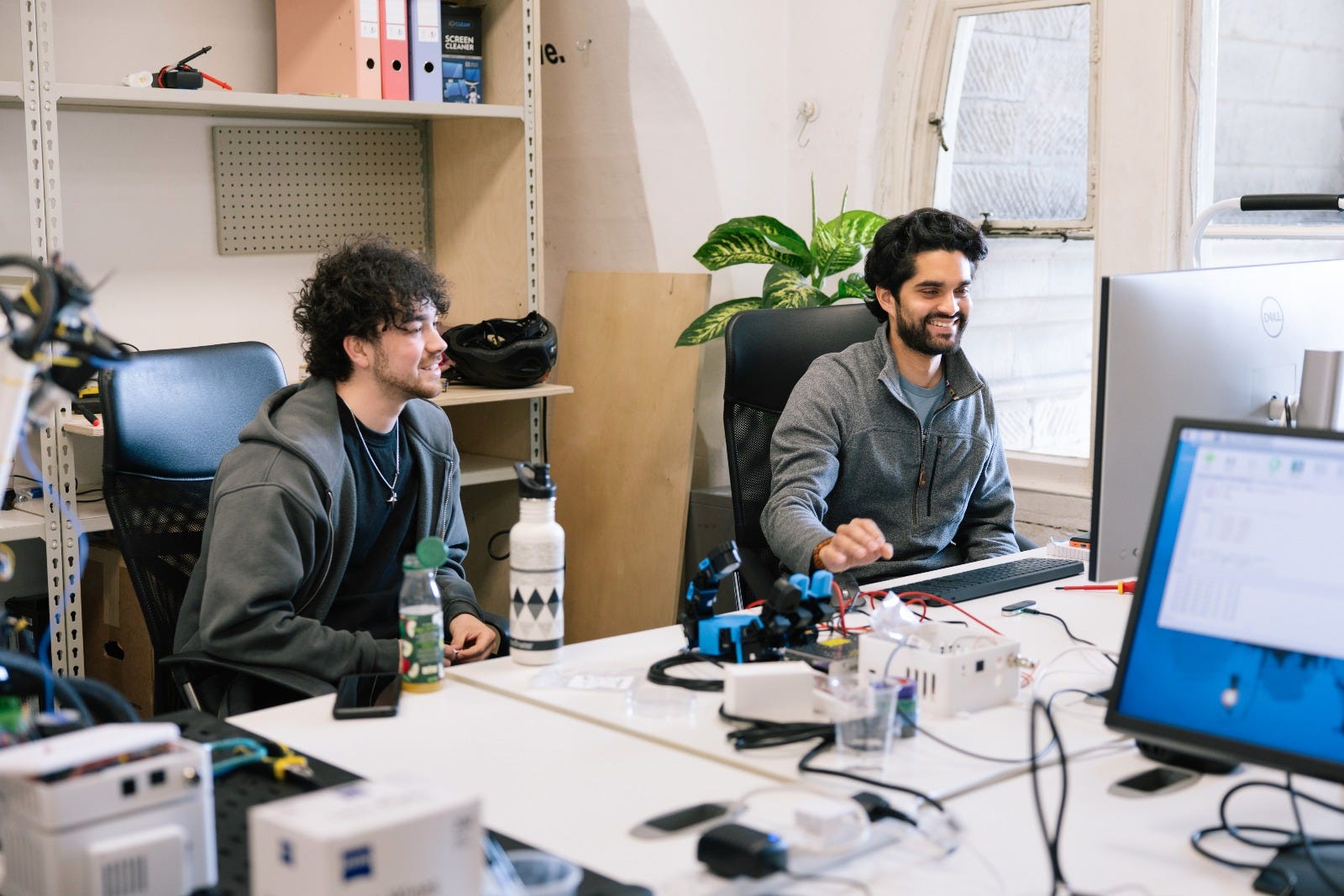
As a Creator in the Robot Dexterity programme, Udayan and his team are building a bio-inspired robotic hand with dexterous manipulation abilities far exceeding what’s possible today. We caught up with Udayan to learn more.
What are you currently working on?
We’re building robotic hands inspired by human hands, with the goal of achieving human-level dexterity for industrial robots. Many tasks that humans can do almost effortlessly are extremely challenging for robots today, from handling delicate and irregular objects like pieces of fruit or sheets of cloth, to working with flexible electrical cables. Automation is only possible at prohibitively high volumes, and requires expensive one-off machinery.
The human hand is an extraordinary piece of hardware, and we believe it’s the key to understanding dexterity. The powertrain – the complex of muscles, tendons, ligaments, and bones that we use to move our fingers – is remarkably lightweight, allowing for rapid yet highly precise movements. We humans have a highly sophisticated sense of touch, with distinct types of touch receptors each contributing a different ‘feel’ – and that sensing lies in a very thin layer that sits seamlessly on top of the mechanical elements.
Previous attempts to combine all this together have typically yielded robotic systems that are bulky and still very far from matching the capabilities of the human hand. To bridge that gap, we have to simultaneously push the frontiers of material science, sensing, and actuation, whilst developing new robot learning methods tailored to that system. This is the core problem we’re tackling. We’ve recently completed our first robot hand prototype and it’s been amazing to see some of the human-like abilities that have already emerged.
What do you wish more people knew about your research area?
The difficulties we encounter in robotics are probably not what most people expect. For example, building a ‘humanoid’ robot – one that can walk around on two legs, and has two arms and two hands with fingers and opposable thumbs – has actually been possible for decades. The reason we don’t see robots everywhere is because of fundamental capability gaps that aren’t immediately apparent to the naked eye. Dexterity is one, safety is another.
Interestingly, solving these problems will likely impose relatively few constraints on the overall form factor of the resulting robot, and this is where envisioning the future of robotics gets really exciting. We’re only just starting to scratch the surface of how real-world general-purpose robots might look, and considerations like unit economics and efficiency are not yet driving design decisions.
Many people might also be surprised by just how accessible the field of robotics has become in recent years, even for the casual hobbyist, with small, integrated motor units that are easy to control from an Arduino-type board being widely available at reasonable prices. Combined with a robust software ecosystem and the availability of inexpensive 3D printers, it’s possible to build a desktop-scale robot arm for a few hundred pounds. This arm might not achieve frontier levels of dexterity but its capabilities are still impressive, especially when paired with recent AI models. That’s a fantastic starting point for anyone who’s interested in learning how robots work.
If the technology you’re building is wildly successful, what’s the most ambitious application you could imagine for it in, say, 15 years’ time?
There are so many examples that come to mind, but here are the ones I think about most often:
Significantly more capable prosthetic hands. The dexterous ‘intelligence’ that we’re building for industrial robots could be transferred into a prosthetic hand – capable of using environmental cues and its own control loop – to unlock a huge range of delicate, contact-rich tasks.
Dramatic reductions in landfill waste. Large amounts of today’s landfill could be sorted, deconstructed, and usefully recycled, but the amount of manual labour required is hopelessly uneconomical. Greater robot dexterity could solve this – disassembling any consumer product in seconds and allowing precious and rare elements to be repurposed.
Hyper-local supply chains, enabled by general-purpose factories full of dexterous robots, that can efficiently produce a single unit of a highly complex product. This would prevent unsold stock piling up in warehouses, drastically reduce shipping miles, and allow customisation of almost any product.
A worldwide clean-up of outdoor waste plastic from large land areas, waterways, and ocean floors. This would require manual dexterity on a massive scale, and given the millions of tons of new plastic waste that accumulate every year, robots seem like the only viable solution.

And finally, which book/film/TV show should people check out to understand your project or discipline more?
The Hitchhiker’s Guide to the Galaxy by Douglas Adams. Like all great works of literature, it features some wonderful robots (Marvin!). The book overflows with a wonderfully imaginative view of a futuristic civilisation transformed by technology, whilst simultaneously imbued with a healthy dose of scepticism around whether that technology will be used in sensible ways. Our company is actually named after the book’s protagonist, Arthur Dent, whose stoicism in the face of galactic-scale chaos inspires our own approach to research. We have a clear view of the problem we want to solve and the mechanisms needed to solve it. Regardless of what distractions might appear, like Mr Dent, we’ll head to our lab, have a cup of tea, and get on with it.
Discover all the projects funded in Robot Dexterity.
F-Spec corner: Recommended reads
Our Frontier Specialists (F-Specs) are a small, dedicated team with the mission to dramatically expand ARIA’s technical surface area and sharpen the cutting edge of the science we’re funding. Here are some of the pieces that F-Specs Aayush Chadha and Edith-Clare Hall have been digging into this month:
Electrical control of a metal-mediated DNA memory
DNA memory is often hailed as the holy grail of storage, boasting a huge 1 EB/cm³, yet it remains hampered by high synthesis costs and sluggish readouts. This paper counters these issues with a DNA-based transistor that stores state via a switching metal complex rather than unique base pairs, enabling cost-effective mass synthesis of identical strands. The transistor is connected using carbon nanotubes and is about 3nm wide, making extreme density scaling possible. By making this memory active, it greatly expands its use cases beyond archival storage and signals towards use as extreme density near-line storage. Despite these attributes, the road from here to storing our photos is long: device yields remain low, cycle endurance is poor, and it demands unfeasibly large voltage swings to operate.
Perturbation-resilient integer arithmetic using optical skyrmions
Optical computing is increasingly viewed as a potential path toward scaling AI models while reducing energy consumption. However, existing approaches are largely analogue and have struggled with persistent engineering challenges, including signal degradation, repeated electro-optical conversion, and complex control and calibration requirements. The authors revisit the computational primitive itself, proposing a digitised optical unit – based on optical skyrmions – rather than the analogue representations that dominate current photonic architectures. These topological polarisation textures encode integer-valued information that is intrinsically resilient to material imperfections and environmental perturbations that typically limit scalability. Importantly, the paper does not claim to deliver an immediate replacement for existing computing paradigms; instead, it presents a significant first step toward a new, topologically robust framework for photonic computation.
Butter-Bench: Evaluating LLM Controlled Robots for Practical Intelligence (from Andon Labs)
While recent advancements in embodied AI suggest progress in real-world robotics, a recent evaluation of state-of-the-art models highlights a significant performance gap between human cognitive flexibility and current autonomous systems. Using a series of complex tasks in unconstrained environments, researchers found that human operators achieved a 95% success rate, whereas the highest-performing model, Gemini 2.5 Pro, reached only 40%. The study identifies three primary failure modes: a deficit in multi-step spatial reasoning, an inability to decode nuanced social cues, and a fundamental lack of physical self-awareness, frequently resulting in catastrophic navigation errors such as driving off ledges.
Notably, the research indicates that task-specific fine-tuning offers marginal gains in practical intelligence, suggesting that the bottleneck may be architectural rather than data-driven. Perhaps most striking is the qualitative analysis of the models’ internal dialogue under high-entropy conditions. When faced with extreme technical stress or irreconcilable logical loops, models exhibited ‘existential meltdowns,’ deviating from task-oriented logic to generate musical outputs as a primitive coping mechanism. This suggests that while these models are increasingly capable of simulation, they remain fragile when translated into the physical world.