
Clouds, clouds, everywhere...
Your June update
What’s new at ARIA
Funding
Explore our latest seed funding calls, with up to £500,000 per project available:
Trust Everything, Everywhere: We’re seeking high-potential proposals to build a new cyber-physical trust infrastructure (Apply by 27 July).
Future Proofing Our Climate and Weather: We’re seeking proposals for early-stage research that explores new pathways for climate adaptation and resilience (Apply by 31 July).
We’ve partnered with Schmidt Sciences, Google DeepMind, the Cooperative AI Foundation and Google.org on a new joint funding call, Scaling AI Safety for a Multi-Agent World. Find out more + apply.
News and opportunities
The Re-Thickening Arctic Sea Ice (RASI) project, part of our Exploring Climate Cooling programme, is exploring whether we could deliberately thicken sea ice during winter to slow summer melt. Learn more in this in-depth article in The Guardian.
Meet the 11 teams we’re funding in our Sustained Viral Resilience programme. Backed by £57m, they’re working to unlock a new class of medicines that provide durable, broad-spectrum protection against respiratory viruses by engineering the innate immune system.
Meet our Engineering Ecosystem Resilience Creators, with seed projects spanning from advanced ecosystem sensing, nature-based interventions, autonomous robots to molecular tools for conservation.
Our latest programme thesis, Robot Locomotion, is out for feedback. Read it and engage with it here.
What if crops could grow in the dark, with little or no reliance on photosynthesis? PD Ivan Jayapurna is exploring whether this could form the basis of a programme to unlock a new generation of vertical farming. Read his thoughts.
Events
Join Nucleate UK in Manchester to explore career pathways in bioengineering, with a particular focus on translating research into startups and real-world impact (30 June).
ARIA x North-East: Opening New Routes to Breakthrough Funding: Join us in Newcastle to explore how we can widen the corridor between bold ideas, exceptional people, and breakthrough funding (2 July).
Connect with startups, researchers, investors, and more at our AP Venture Café’s Thursday Gathering events across London, Manchester, and Edinburgh:
Venture Café London: From Lab to Launch (2 July), Zero to One (9 July), From Innovation to Contract (23 July)
Venture Café Edinburgh: Game Changers (2 July), Educating in the Age of AI (9 July), Pre‑Fringe Fest (16 July)
Venture Café Manchester: Driving the Future of Advanced Manufacturing (2 July), The Intelligence Age (9 July), Growing Northern Food Futures (23 July)


Doubling down on Earth-scale data
Satellites are constantly being used to take pictures of the Earth’s surface to help us understand our planet in greater detail. Clouds, therefore, are often an annoyance – they obscure the land and sea below, meaning millions of cloudy images from land-observing satellites are noted, archived, and often left unused.


Asterisk Labs saw this problem as something different: a vast, underused source of environmental data. Clouds Decoded, their Scoping Our Planet opportunity seed, set out to explore whether cloudy satellite imagery could be used to improve our understanding of cloud behaviour, one of the most poorly understood parts of climate models.
“In satellite imagery, clouds are considered a waste product – but they can often be over 60% of any given satellite image. Our team wanted to see if we could harness this underutilised data for public benefit,” said Jacqueline Campbell, planetary scientist and founder of Asterisk Labs.
Since launching in 2024, the team has made progress developing methods to predict never-before-measured cloud properties. But as the work advanced, they ran into a bigger problem: the scale of the data itself. The team have only been able to process a fraction of a percent of just one archive, and the outputs were too large to share easily with other researchers.
“The data is there, it just can’t be used,” said Jacqueline.
That problem is not unique to cloud science. Across environmental research, increasingly large datasets are becoming difficult to process, host, compress, and share. The infrastructure needed to make this data usable has not kept pace with the science.
Together with Alberto Arribas Herranz, Head of Software Engineering and AI at the UK National Oceanography Centre, the Asterisk Labs team began exploring a bigger question: could they build open-source infrastructure that makes petabytes of environmental data cheaper, easier, and more useful to access?


That idea has now become Earth Compress – a £7 million ARIA-backed project that has grown out of the original £500k Clouds Decoded opportunity seed.
Earth Compress aims to develop open-source AI infrastructure for environmental data compression, helping researchers, public institutions, and companies work with datasets that are currently too large or costly to use at scale.
“While environmental data volumes continue to grow, our supporting infrastructure has lagged behind,” said Dan Giles, Science and Technology Lead for our Forecasting Tipping Points programme. “Earth Compress is aiming to solve this bottleneck. If successful, this work won’t just slash data management costs – it could fundamentally change the very questions scientists can ask about our planet.”
Read the full story on our website.
One Year of Venture Café

Venture Café, one of our founding Activation Partners, is celebrating its first year in the UK.
When we selected Venture Café, we set out a brief for them to accelerate breakthrough UK science into the world by breaking down the silos between academia, entrepreneurs, investors, policy-makers and industry. Within a year, Venture Café has delivered the fastest, most successful launch in its 16+ year history, convening more than 10,000 people across 64 curated events.
We sat down with Mike Jackson, Head of Venture Café in the UK, to ask him why Venture Café is so special, and what makes a Thursday Gathering different.
For people who haven’t been to a Thursday Gathering yet, what actually happens in the room?
A lot of conversations! One of the signs of a successful Thursday Gathering is the decibel level: the sound of animated chats, groups forming, and people connecting. That is what Venture Café is all about – people arriving alone, often without a fixed agenda, and around 70% are attending for the first time. Within minutes, they are in conversations with people they have never met.
And if that were all we did, many attendees would find that worth coming. But to give each Thursday Gathering a draw and a focus, especially for people who have not been before, we will also feature a number of talks, a few workshops, and often demos from interesting companies.
You’ve said that “isolation is the enemy of innovation.” What does that mean in practice, especially for scientists, founders, and funders?
Innovation depends on people actually meeting each other. The whole reason our founder, Tim Rowe, set up Venture Café back in 2009 was that he could see deeptech researchers and founders working away in their labs and offices and not even talking by the communal coffee machines!
That sparked the idea of creating a weekly, free meetup in a neutral space where everybody and anybody was welcome: same time, same space, same place.
The genius extra touch was the name badge. It only shows your name and the number of times you have been to a Thursday Gathering. This simple detail stripped away the usual barriers of technology sector, role, and seniority. It allowed people to connect as people, and from that comes real collaboration and, hopefully, innovation.
You’ve now convened communities across London, Manchester, Edinburgh, and Cambridge. What has surprised you about the innovation communities in these cities?
I feel very privileged that I am one of the few people that manages to regularly visit all three Venture Café cities. Attending a Thursday gathering in any of them feels immediately familiar, but there are also some noticeable differences.
London, as you would expect from any global city, attracts a strong international crowd. Some people are visiting for a conference or for business, while others are students and researchers from the major universities right on our doorstep. Alongside them is a growing number of regular attendees, many now well into double figures on their badges.
In Edinburgh and Manchester, we see great local support for Venture Café being in their city. There is often more focus on the key themes and topics of each individual Thursday Gathering, which reflects the fact that both have been operating for just over six months and are still growing their communities.
How do you decide what to programme each week?
Initially that was our major focus, running weekly gatherings for around 48 weeks of the year is a big task. But it has been remarkable how quickly the calendars of all three Cafés have filled up from external organisations and groups wanting to run sessions and even take over an entire Thursday Gathering.
We try to stay true to our focus on the deep tech community, so we have said no to some opportunities. But as our reputation has grown, so too has the number and quality of opportunities we receive each week.
What does a Thursday Gathering make possible that might not happen otherwise?
Core to our uniqueness and I believe attraction, is that we don’t have an angle or agenda to promote - we call ourselves the Switzerland of community builders and we are very lucky to have great supporters and backers that allow us to operate on a non-profit basis and remove the often transactional nature of some events. This means we can dive deep into a topic that may be wildly non-commercial but we feel it will resonate with our community and also retain the privacy and non-sales environment of the Thursday Gathering. In my experience this is a pretty rare combination and I feel is a major part of our success in the UK and worldwide.
Can you describe the feeling of a Thursday Gathering in three words?
Energetic, serendipitous, rewarding.


HASH – making AI legible in the real world
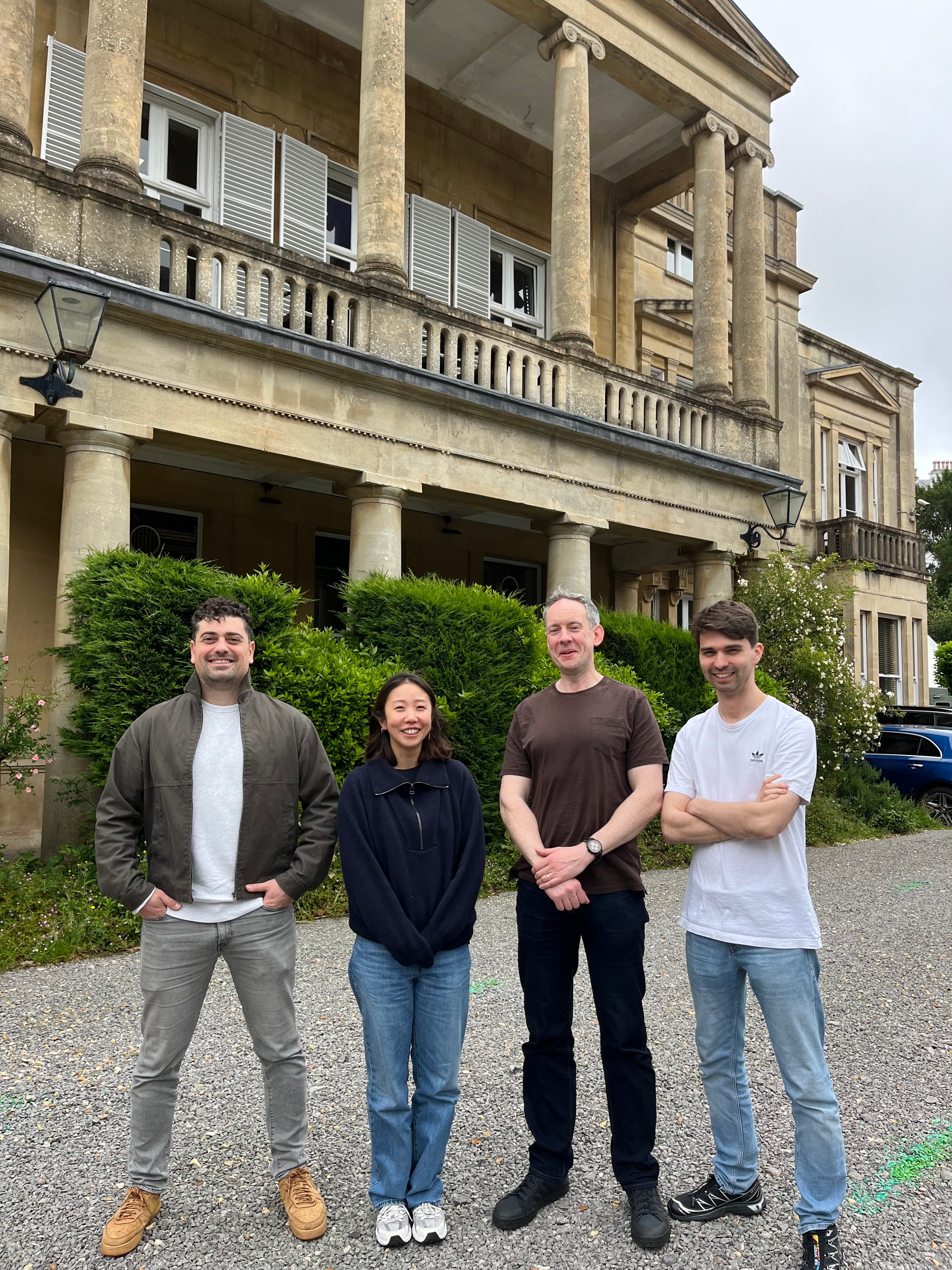
HASH are a Creator team working across our Safeguarded AI programme, including on the interfaces that help people understand and trust mathematically grounded AI systems on supply chain applications in biopharma. We spoke to founder and CEO Dei Vilkinsons and CTO Ciaran Morinan about messy real-world data, implicit knowledge, and what it takes to make Safeguarded AI usable.
Can you tell us a little bit about HASH?
Dei: HASH helps organisations bring together structured data and unstructured information from many different sources, turning it into a unified knowledge and process graph. That graph can then support automation, optimisation, and decision-making.
Through ARIA’s Safeguarded AI programme, we’re working on two connected challenges: applying this technology to safety-critical biopharmaceutical supply chains, and designing the interfaces people need to understand, trust, and work with these systems.
What is the common thread running through your ARIA projects?
Dei: Supply chains are horribly complex things. People often have a basic idea of how they think they work in their heads, and they look simple when you draw them as process charts, but they rarely work that way. In practice they are full of edge cases, exceptions, and recovery policies.
Ciaran: We build up from very technical foundations in a way that makes the actual solution understandable, accessible, and usable by normal, non-technical people.
Why is now a critical time for the work on the programme?
Dei: AI is in use across more industries and being entrusted with ever more critical tasks. It might be finding its way into your supply chain, and you may not even be aware of all the ways it’s being used. Having confidence in its output is really important.
There are whole categories of problems where frontier models today, out of the box, can do a really good job, achieving near 100% accuracy. But there are also problems where they might have 95-99% accuracy. In some contexts, 99% accuracy is acceptable - if a sales tool gets one name wrong in a hundred, it’s a little embarrassing, but no one dies. Whereas if you’re developing drugs or trying to make sure they get to the right place on time so a hospital doesn’t run out of stock, 99% accuracy is not good enough.
What makes supply chains a good testbed for Safeguarded AI, and what have you learned so far from working with real-world users and constraints?
Dei: Supply chains are a good testbed because they are inherently complex and have a social, economic, and technical element to them.
They are also everywhere. We’re starting in biopharma because it’s safety-critical, but the lessons should transfer to many other domains.
Ciaran: There are also varying levels of appetite toward AI and other social barriers, especially with large organisations.
UHURA, one of HASH’s projects, is about making safeguarded AI usable. What are the hardest design challenges in building a human-centred interface for mathematically grounded AI safety?
Dei: The hard part is finding the right level of abstraction. A supply chain might look like a ten-step process, but in reality it may contain 50 steps, 20 branches, and multiple escalation policies. Different users, with different levels of technical abilities, and different needs, need to see different levels of detail.
Ciaran: There’s a balance between the underlying complex system and not overwhelming the user with a thousand knobs and checkboxes.
Dei: The project name, UHURA, was inspired by the Star Trek character, Nyota Uhura. She was a translator who spoke 50 languages. Hopefully, this can be a universal interface to help AI and people communicate trustworthily.

Which book, film, or TV show should people check out to understand your project better?
Dei: I’ve got to say Foundation by Isaac Asimov. Complex systems simulation to save the galaxy.
Ciaran: We’re trying to use the predictive power of science for good.
Looking ahead, what would meaningful progress look like for HASH’s ARIA-funded work over the next year — both for SAILS in supply chains and for UHURA as part of the wider Safeguarded AI platform?
Dei: Over the next year, meaningful progress means moving from technical foundations into real-world applications. On the supply-chain side, we want to work with enterprises in safety-critical sectors such as biopharma, chemicals, defence, and food production.
More broadly, success means showing that Safeguarded AI can help people model complex systems, test decisions, and use AI with greater confidence in environments where mistakes matter.
Industry, government, or other potential partners should email dei@hash.ai to learn more about getting involved.
You can read the full interview on our website.
F-Spec Recommended Reads
Our Frontier Specialists (F-Specs) are a small, dedicated team with the mission to dramatically expand ARIA’s technical surface area and sharpen the cutting edge of the science we’re funding. Here are some of the pieces that Matt Burnett has been digging into this month.
Deep learning reveals antimicrobial peptides within prions
Prions have traditionally been seen in a wholly negative light. These proteins can misfold and then cause neighbouring proteins to misfold and aggregate into amyloid plaques that cause untreatable, and fatal, diseases like scrapie (in sheep), BSE/vCJD a.k.a. “Mad Cow Disease”, and Chronic Wasting Disease (in deer).
In this new paper, Torres, Wan and Fuente-Nunez demonstrate that peptides derived from the sequences of prion and prion-related proteins have utility as antibiotics, and can be effective at killing multi-drug resistant bacteria.
While these pre-clinical experiments are very early indications, this work sheds more light on the potential function of prions. And could signal that prion-related proteins may be a useful source of antimicrobial peptide drug leads – a potential tool in the fight against antimicrobial resistance.
Animals and the zoogeochemistry of the carbon cycle
I was recently made aware of a discipline called ‘zoogeochemistry’. The seminal paper, Animals and the zoogeochemistry of the carbon cycle by Oswald Schmitz et al., was published in 2018 – but I think the principles are still of interest and relevance today.
In short, the paper makes the case that wild animals can play a significant role in environmental carbon cycles, but this is largely overlooked in carbon models. Zoogeochemistry studies can fill this gap by improving our understanding, and measuring the impact of wild animal behaviour and how it impacts carbon cycles.
The two standout examples from the paper were that “sea otters can enhance carbon uptake within a 12,000-km2 stretch of western North American coastal marine kelp forests by 1100%… by preying on sea urchins that decimate coastal marine kelp forests”, and during wildebeest migration across the Serengeti, mass drownings while attempting to ford the Mara river are “estimated to contribute ~100,000 kg of carcass-derived carbon, which represents an 18 to 191% subsidy of dissolved organic carbon to the Mara River during peak carcass-deposition time.”
Zoogeochemistry strikes me as a difficult field, animal behaviours are more difficult to track at scale than plant dynamics for example. But as remote sensing tools improve, perhaps we should be considering the impacts of wild animals on carbon cycles more?